Dynamic Iteration Schemes
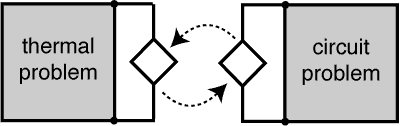
Dynamic iteration via source coupling
Standard time-integration methods solve transient problems all at once. This may become very inefficient or impossible for large systems of equations. Imaging that such large systems often stem from a coupled problem formulation, where different physical phenomena interact and need to be coupled in order to produce a precise mathematical model.
E.g. highly integrated electric circuits (as in memory chips or CPUs) produce heat, which effects in turn their behavior as electrical system; thus one needs to couple electric and thermal subproblem descriptions. On the one hand, this creates multiple time scales due to different physical phenomena, which demands an efficient treatment, see multirate. On the other hand, in a professional environment one usually has dedicated solvers for the subproblems, which need to be used, and an overall problem formulation is not feasible for any of the involved tools.
For those partitioned problems a dynamic iteration method becomes beneficial or even the sole way-out: it keeps the subproblems separate, solves subproblems sequentially (or in parallel) and iterates until convergence (fixed-point interation). Thus the subproblem's structure can be exploited in the respective integration.
To guarantee or to speed up convergence the time interval of interest is split into a series of windows. Then the time-integration of the windows is applied sequentially and in each window the subproblems are solved iteratively by your favoured method.
Group members working on that field
- Andreas Bartel
- Michael Günther
Former and ongoing Projects
Cooperation
- Herbert De Gersem, Katholieke Universiteit Leuven
Publications
- 2026
5592.
Kiesling, Elisabeth; Grandrath, Rebecca; Bohrmann-Linde, Claudia
Von der Querschnittsaufgabe BNE zur Unterrichtsplanung: Ein Umsetzungsbeispiel zum Thema Fette für den Chemieunterricht der Sekundarstufe II
MNU-Journal, 02/2026 :141-146
März 20265591.
Kunze, Markus; Mui, Jonathan; Ploss, David
Elliptic operators with non-local Wentzell-Robin boundary conditions
Journal of Spectral Theory
Februar 20265590.
Barmin, Roman A.; Moosavifar, MirJavad; Rama, Elena; Blöck, Julia; Rix, Anne; Petrovskii, Vladislav S.; Gumerov, Rustam A.; Köhler, Jens; Pohl, Michael; Bastard, Céline; Rütten, Stephan; Charlton, Laura; Khiêm, Vu Ngoc; Domenici, Fabio; Lisson, Thomas; Savina, Ekaterina; Zhang, Rui; Baier, Jasmin; Koletnik, Susanne; Koutsos, Vasileios; Itskov, Mikhail; Paradossi, Gaio; Schmitz, Georg; Vermonden, Tina; De Laporte, Laura; Göstl, Robert; Herrmann, Andreas; Potemkin, Igor I.; Kiessling, Fabian; Lammers, Twan; Pallares, Roger M.
Microbubble Shell Stiffness Engineering Enhances Ultrasound Imaging, Drug Delivery, and Sonoporation
Advanced Materials, 38 (6) :e07655
Januar 2026
ISSN: 1521-40955589.
Tapera, Michael; Savvidis, Athanasios; Meysing, Cedric; Gómez-Suárez, Adrián; Kirsch, S. F.
Oxidative Cleavage of β-Substituted Primary Alcohols in Flow
Organic Letters
Januar 2026
Herausgeber: ACS
ISSN: 1523-70525588.
Prinz, Kathrin; Nemesch, Levin; Ruzika, Stefan
A High-Performance Parallel Algorithm for Multi-Objective Integer Optimization
20265587.
Ocqueteau, Vicente
Analysis of a Model for a Floating Platform Coupled with a Flexible Beam
20265586.
Elghazi, Bouchra; Jacob, Birgit; Zwart, Hans
Boundary control systems on a one-dimension spatial domain
20265585.
Sinani, Mario A.; Palacios, Rafael; Fasel, Urban; Wynn, Andrew
Data-Driven Parametric Aeroelastic Modeling of the Pazy Wing
20265584.
Finster, Rebecca; Grogorick, Linda; Robra-Bissantz, Susanne
Einheitliche Vorgaben, heterogene Praxis: Potenziale der NIS2-Umsetzung in einer öffentlichen Verwaltung
HMD - Praxis der Wirtschaftsinformatik
20265583.
Zeller, Diana; Bohrmann-Linde, Claudia
KI-Chatbots als Unterrichtswerkzeug: Eine Lehrkräftefortbildung zum Einsatz von KI-Chatbots im Chemieunterricht
CHEMKON
2026
angenommen5582.
Könen, David; Stiglmayr, Michael
Output-sensitive Complexity of Multi-Objective Integer Network Flow Problems
Journal of Combinatorial Optimization, 51 (14)
20265581.
Yuden, Kezang; Nemesch, Levin; Ruzika, Stefan
Parametric Biobjective Linear Programming
20265580.
Lopes, Gonçalo; Klamroth, Kathrin; Paquete, Luís
Solving hypervolume scalarizations for MOCO problems
20265579.
Acu, A.M.; Heilmann, Margareta; Raşa, I.
Convergence of linking Durrmeyer type modifications of generalized Baskatov operators
Bulleting of the Malaysian Math. Sciences Society5578.
Ehrhardt, Matthias
Ein einfaches Kompartment-Modell zur Beschreibung von Revolutionen am Beispiel des Arabischen Frühlings5577.
Günther, Michael
Einführung in die Finanzmathematik5576.
Al{\i}, G; Bartel, A
Electrical RLC networks and diodes5575.
Gjonaj, Erion; Bahls, Christian Rüdiger; Bandlow, Bastian; Bartel, Andreas; Baumanns, Sascha; Belzen, F; Benderskaya, Galina; Benner, Peter; Beurden, MC; Blaszczyk, Andreas; others
Feldmann, Uwe, 143 Feng, Lihong, 515 De Gersem, Herbert, 341 Gim, Sebasti{\'a}n, 45, 333
MATHEMATICS IN INDUSTRY 14 :5875574.
Ehrhardt, Matthias
für Angewandte Analysis und Stochastik5573.
Ehrhardt, Matthias; Günther, Michael; Striebel, Michael
Geometric Numerical Integration Structure-Preserving Algorithms for Lattice QCD Simulations5572.
High order tensor product interpolation in the Combination Technique
preprint, 14 :255571.
Hendricks, Christian; Ehrhardt, Matthias; Günther, Michael
Hybrid finite difference/pseudospectral methods for stochastic volatility models
19th European Conference on Mathematics for Industry, Seite 3885570.
Ehrhardt, Matthias; Csomós, Petra; Faragó, István; others
Invited Papers5569.
Günther, Michael
Lab Exercises for Numerical Analysis and Simulation I: ODEs5568.
Ehrhardt, Matthias; Günther, Michael
Mathematical Modelling of Dengue Fever Epidemics