Dynamic Iteration Schemes
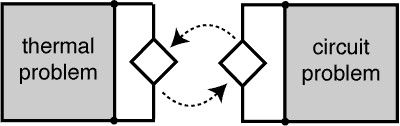
Dynamic iteration via source coupling
Standard time-integration methods solve transient problems all at once. This may become very inefficient or impossible for large systems of equations. Imaging that such large systems often stem from a coupled problem formulation, where different physical phenomena interact and need to be coupled in order to produce a precise mathematical model.
E.g. highly integrated electric circuits (as in memory chips or CPUs) produce heat, which effects in turn their behavior as electrical system; thus one needs to couple electric and thermal subproblem descriptions. On the one hand, this creates multiple time scales due to different physical phenomena, which demands an efficient treatment, see multirate. On the other hand, in a professional environment one usually has dedicated solvers for the subproblems, which need to be used, and an overall problem formulation is not feasible for any of the involved tools.
For those partitioned problems a dynamic iteration method becomes beneficial or even the sole way-out: it keeps the subproblems separate, solves subproblems sequentially (or in parallel) and iterates until convergence (fixed-point interation). Thus the subproblem's structure can be exploited in the respective integration.
To guarantee or to speed up convergence the time interval of interest is split into a series of windows. Then the time-integration of the windows is applied sequentially and in each window the subproblems are solved iteratively by your favoured method.
Group members working on that field
- Andreas Bartel
- Michael Günther
Former and ongoing Projects
Cooperation
- Herbert De Gersem, Katholieke Universiteit Leuven
Publications
- 1994
493.
Auwera, J. Vander; Holland, J. K.; Jensen, Per; Johns, John W. C.
The \(\nu\)\(_{6}\) band system of C\(_{3}\)O\(_{2}\) near 540 cm\(^{-1}\)
Journal of Molecular Spectroscopy, 163 (2) :529-540
1994
Herausgeber: Academic Press492.
Auwera, J. Vander; Holland, J. K.; Jensen, Per; Johns, John W. C.
The \(\nu\)\(_{6}\) band system of C\(_{3}\)O\(_{2}\) near 540 cm\(^{-1}\)
Journal of Molecular Spectroscopy, 163 (2) :529-540
1994
Herausgeber: Academic Press491.
Breidohr, R.; Shestakov, Oleg; Fink, Ewald H.
The a \(^{3}\)\(\Sigma\)\(^{+}\) (a\(_{1}\) 1) → X \(^{1}\)\(\Sigma\)\(^{+}\) (X 0\(^{+}\)) Transitions of BiP, BiAs, and BiSb
Journal of Molecular Spectroscopy, 168 (1) :126-135
1994
Herausgeber: Academic Press490.
Breidohr, R.; Shestakov, Oleg; Fink, Ewald H.
The a \(^{3}\)\(\Sigma\)\(^{+}\) (a\(_{1}\) 1) → X \(^{1}\)\(\Sigma\)\(^{+}\) (X 0\(^{+}\)) Transitions of BiP, BiAs, and BiSb
Journal of Molecular Spectroscopy, 168 (1) :126-135
1994
Herausgeber: Academic Press489.
Breidohr, R.; Setzer, Klaus-Dieter; Shestakov, Oleg; Fink, Ewald H.; Zyrnicki, W.
The a \(^{3}\)\(\Sigma\)\(_{u}\)\(^{+}\) (a\(_{1}\) 1\(_{u}\)) → X \(^{1}\)\(\Sigma\)\(_{g}\)\(^{+}\) (X 0\(_{g}\)\(^{+}\)) Transition of Bi\(_{2}\)
Journal of Molecular Spectroscopy, 166 (2) :251-263
1994
Herausgeber: Academic Press488.
Breidohr, R.; Setzer, Klaus-Dieter; Shestakov, Oleg; Fink, Ewald H.; Zyrnicki, W.
The a \(^{3}\)\(\Sigma\)\(_{u}\)\(^{+}\) (a\(_{1}\) 1\(_{u}\)) → X \(^{1}\)\(\Sigma\)\(_{g}\)\(^{+}\) (X 0\(_{g}\)\(^{+}\)) Transition of Bi\(_{2}\)
Journal of Molecular Spectroscopy, 166 (2) :251-263
1994
Herausgeber: Academic Press487.
Breidohr, R.; Shestakov, Oleg; Fink, Ewald H.
The a \(^{3}\)\(\Sigma\)\(_{u}\)\(^{+}\)(a\(_{1}\) 1\(_{u}\)) → X \(^{1}\)\(\Sigma\)\(_{g}\)\(^{+}\) (X 0\(_{g}\)\(^{+}\)) transition of Sb\(_{2}\)
Chemical Physics Letters, 218 (1-2) :13-16
1994486.
Breidohr, R.; Shestakov, Oleg; Fink, Ewald H.
The a \(^{3}\)\(\Sigma\)\(_{u}\)\(^{+}\)(a\(_{1}\) 1\(_{u}\)) → X \(^{1}\)\(\Sigma\)\(_{g}\)\(^{+}\) (X 0\(_{g}\)\(^{+}\)) transition of Sb\(_{2}\)
Chemical Physics Letters, 218 (1-2) :13-16
1994485.
Breidohr, R.; Setzer, Klaus-Dieter; Shestakov, Oleg; Fink, Ewald H.; Zyrnicki, W.
The a 3Σu+ (a1 1u) → X 1Σg+ (X 0g+) Transition of Bi2
Journal of Molecular Spectroscopy, 166 (2) :251-263
1994
Herausgeber: Academic Press484.
Breidohr, R.; Shestakov, Oleg; Fink, Ewald H.
The a 3Σu+(a1 1u) → X 1Σg+ (X 0g+) transition of Sb2
Chemical Physics Letters, 218 (1-2) :13-16
1994483.
Breidohr, R.; Shestakov, Oleg; Fink, Ewald H.
The a 3Σ+ (a1 1) → X 1Σ+ (X 0+) Transitions of BiP, BiAs, and BiSb
Journal of Molecular Spectroscopy, 168 (1) :126-135
1994
Herausgeber: Academic Press482.
Shestakov, Oleg; Fink, Ewald H.
The a\(^{1}\)\(\Delta\)(a2) state of BiF
Chemical Physics Letters, 229 (3) :273-278
1994481.
Shestakov, Oleg; Fink, Ewald H.
The a\(^{1}\)\(\Delta\)(a2) state of BiF
Chemical Physics Letters, 229 (3) :273-278
1994480.
Shestakov, Oleg; Fink, Ewald H.
The a1Δ(a2) state of BiF
Chemical Physics Letters, 229 (3) :273-278
1994479.
Tashkun, Sergey A.; Jensen, Per
The low-energy part of the potential function for the electronic ground state of NO\(_{2}\) derived from experiment
Journal of Molecular Spectroscopy, 165 (1) :173-184
1994
Herausgeber: Academic Press478.
Tashkun, Sergey A.; Jensen, Per
The low-energy part of the potential function for the electronic ground state of NO\(_{2}\) derived from experiment
Journal of Molecular Spectroscopy, 165 (1) :173-184
1994
Herausgeber: Academic Press477.
Tashkun, Sergey A.; Jensen, Per
The low-energy part of the potential function for the electronic ground state of NO2 derived from experiment
Journal of Molecular Spectroscopy, 165 (1) :173-184
1994
Herausgeber: Academic Press476.
Jensen, Per; Bunker, Philip R.
The Molecular Symmetry Group for Molecules in High Angular Momentum States
Journal of Molecular Spectroscopy, 164 (1) :315-317
1994
Herausgeber: Academic Press475.
Jensen, Per; Bunker, Philip R.
The Molecular Symmetry Group for Molecules in High Angular Momentum States
Journal of Molecular Spectroscopy, 164 (1) :315-317
1994
Herausgeber: Academic Press474.
Jensen, Per; Bunker, Philip R.
The Molecular Symmetry Group for Molecules in High Angular Momentum States
Journal of Molecular Spectroscopy, 164 (1) :315-317
1994
Herausgeber: Academic Press473.
Bednarek, G.; Wayne, R.P.; Wildt, J{ü}rgen; Fink, E.H.
The yield of O\(_{2}\)(b \(^{1}\)\(\Sigma\)\(_{g}\)\(^{+}\), v=0) produced by quenching of O\(_{2}\)(A \(^{3}\)\(\Sigma\)\(_{u}\)\(^{+}\), v=8) by O\(_{2}\)
Chemical Physics, 185 (2) :251-261
1994472.
Bednarek, G.; Wayne, R.P.; Wildt, J{ü}rgen; Fink, E.H.
The yield of O\(_{2}\)(b \(^{1}\)\(\Sigma\)\(_{g}\)\(^{+}\), v=0) produced by quenching of O\(_{2}\)(A \(^{3}\)\(\Sigma\)\(_{u}\)\(^{+}\), v=8) by O\(_{2}\)
Chemical Physics, 185 (2) :251-261
1994471.
Bednarek, G.; Wayne, R.P.; Wildt, Jürgen; Fink, E.H.
The yield of O2(b 1Σg+, v=0) produced by quenching of O2(A 3Σu+, v=8) by O2
Chemical Physics, 185 (2) :251-261
1994470.
Auwera, J. Vander; Holland, J. K.; Jensen, Per; Johns, John W. C.
The ν6 band system of C3O2 near 540 cm-1
Journal of Molecular Spectroscopy, 163 (2) :529-540
1994
Herausgeber: Academic Press- 1993
469.
Graf, J.; Jensen, Per
A Theoretical Model for the Rotation and Vibration of Symmetrical Triatomic Molecules with Strong Coupling Between the Local Stretching Modes
Journal of Molecular Spectroscopy, 159 (1) :175-191
1993
Herausgeber: Academic Press