
Multirate
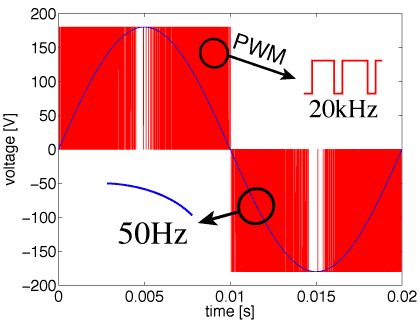
Highly integrated electric cicuits show a phenomenon called latency. That is, a processed signal causes activity only in a small subset of the whole circuit (imagine a central processing unit), whereas the other part of the system behaves almost constant over some time - is latent. Such an electric system can be described as coupled system, where the waveforms show different time scales, also refered to as multirate.
More generally, any coupled problem formulation due to coupled physical effects, may cause a multirate problem: image the simulation of car driving on the road, there you need a model for the wheel, the chassis, the dampers, the road,... (cf. co-simulation). Again each system is covered by their own time constant, which might vary over several orders of magnitude comparing different subsystems.
Classical methods cannot exploit this multirate potential, but resolve everything on the finest scale. This causes an over sampling of the latent components. In constrast, Co-simulation or especially dedicated multirate methods are designed to use the inherent step size to resolve the time-domain behaviour of each subystem with the required accuracy. This requires a time-stepping for each.
Group members working in that field
- Andreas Bartel
- Michael Günther
Former and ongoing Projects
- CoMSON
- ICESTARS
- 03GUNAVN
Cooperations
- Herbert de Gersem, K.U. Leuven, Belgium
- Jan ter Maten, TU Eindhoven and NXP, the Netherlands
Publications
- 1986
181.
Adams, Warren P; Sherali, Hanif D
A tight linearization and an algorithm for zero-one quadratic programming problems
Management Science, 32 (10) :1274--1290
1986
Publisher: INFORMS180.
Bunker, Philip R.; Jensen, Per; Kraemer, Wolfgang P.; Beardsworth, R.
The potential surface of X~3B1 methylene (CH2) and the singlet-triplet splitting
The Journal of Chemical Physics, 85 (7) :3724-3731
1986179.
Kraemer, Wolfgang P.; Roos, B. O.; Bunker, Philip R.; Jensen, Per
An ab initio calculation of the rotation-vibration energies of the state of CCH using the nonrigid bender Hamiltonian
Journal of Molecular Spectroscopy, 120 (1) :236-238
1986178.
Jensen, Per; Bunker, Philip R.
The nonrigid bender Hamiltonian using an alternative perturbation technique
Journal of Molecular Spectroscopy, 118 (1) :18-39
1986177.
Beardsworth, R.; Bunker, Philip R.; Jensen, Per; Kraemer, Wolfgang P.
Rotation-vibration energy levels of H2O and C3 calculated using the nonrigid bender Hamiltonian
Journal of Molecular Spectroscopy, 118 (1) :50-63
1986176.
Bielefeld, M.; Wildt, Jürgen; Fink, Ewald H.
Rate constants of the near-resonant E-E energy exchange processes SeS(b0+) + O2(X3Σg-) ↔ SeS(X10+) + O2(a1Δg)
Chemical Physics Letters, 126 (5) :421-426
1986175.
Maten, E. Jan W.; Sleijpen, Gerard L. G.
A convergence analysis of Hopscotch methods for fourth order parabolic equations
Numerische Mathematik, 49 (2-3) :275--290
March 1986
Publisher: Springer Science and Business Media {LLC}174.
Maten, E. J. W.
Splitting methods for fourth order parabolic partial differential equations
Computing, 37 (4) :335--350
December 1986
Publisher: Springer Science and Business Media {LLC}173.
Jensen, Per; Spirko, Vladimír; Bunker, Philip R.
A new Morse-oscillator based Hamiltonian for H3+: Extension to H2D+ and D2H+
Journal of Molecular Spectroscopy, 115 (2) :269-293
1986172.
Jensen, Per; Johns, John W. C.
The infrared spectrum of carbon suboxide in the ν6 fundamental region: Experimental observation and semirigid bender analysis
Journal of Molecular Spectroscopy, 118 (1) :248-266
1986171.
Fink, Ewald H.; Kruse, H.; Ramsay, D. A.
The high-resolution emission spectrum of S2 in the near infrared: The b1Σg+ - X3Σg- system
Journal of Molecular Spectroscopy, 119 (2) :377-387
1986170.
Vojtík, Jan; Spirko, Vladimír; Jensen, Per
Vibrational energies of H3+ and Li3+ based on the diatomics-in-molecules potentials
Collection of Czechoslovak Chemical Communications, 51 (10) :2057-2062
1986
Publisher: Institute of Organic Chemistry and Biochemistry AS CR, v.v.i.- 1985
169.
Winkler, R.
Path-following for two-point boundary value problems
, Seminarbericht 78 der Sektion MathematikVolume78
Humboldt-Universität zu Berlin
1985168.
Lamour, R.; Hanke, M.; Winkler, R.
The program system ‘RWA’ (version 2) for the solution of TPBVP - fundamentals and algorithms
, Seminarbericht 67 der Sektion MathematikVolume67
Humboldt-Universität zu Berlin
1985167.
Holstein, K. J.; Fink, Ewald H.; Wildt, J{ü}rgen; Zabel, Friedhelm
A\verb=~=\(^{2}\)A' → X\verb=~=\(^{2}\)A'' emission spectrum of the HS\(_{2}\) radical
Chemical Physics Letters, 113 (1) :1-7
1985166.
Spirko, Vladim{í}r; Jensen, Per; Bunker, Philip R.; Cejchan, A.
The development of a new Morse-oscillator based rotation-vibration Hamiltonian for H\(_{3}\)\(^{+}\)
Journal of Molecular Spectroscopy, 112 (1) :183-202
1985165.
Phillips, R.A.; Buenker, Robert J.; Beardsworth, R.; Bunker, Philip R.; Jensen, Per; Kraemer, Wolfgang P.
An ab initio study of the rotation-vibration energy levels of GeH\(_{2}\) in the a\verb=~=\(^{3}\)B\(_{1}\) state
Chemical Physics Letters, 118 (1) :60-63
1985164.
Holstein, K. J.; Fink, Ewald H.; Wildt, J{ü}rgen; Zabel, Friedhelm
A\verb=~=\(^{2}\)A' → X\verb=~=\(^{2}\)A'' emission spectrum of the HS\(_{2}\) radical
Chemical Physics Letters, 113 (1) :1-7
1985163.
Spirko, Vladim{í}r; Jensen, Per; Bunker, Philip R.; Cejchan, A.
The development of a new Morse-oscillator based rotation-vibration Hamiltonian for H\(_{3}\)\(^{+}\)
Journal of Molecular Spectroscopy, 112 (1) :183-202
1985162.
Phillips, R.A.; Buenker, Robert J.; Beardsworth, R.; Bunker, Philip R.; Jensen, Per; Kraemer, Wolfgang P.
An ab initio study of the rotation-vibration energy levels of GeH\(_{2}\) in the a\verb=~=\(^{3}\)B\(_{1}\) state
Chemical Physics Letters, 118 (1) :60-63
1985161.
Holstein, K. J.; Fink, Ewald H.; Wildt, Jürgen; Zabel, Friedhelm
A~2A' → X~2A" emission spectrum of the HS2 radical
Chemical Physics Letters, 113 (1) :1-7
1985160.
Tausch, Michael W.
Aktivierungsenergie - was ist das?
Praxis der Naturwissenschaften (Chemie), 34 :33
1985159.
Spirko, Vladimír; Jensen, Per; Bunker, Philip R.; Cejchan, A.
The development of a new Morse-oscillator based rotation-vibration Hamiltonian for H3+
Journal of Molecular Spectroscopy, 112 (1) :183-202
1985158.
Phillips, R.A.; Buenker, Robert J.; Beardsworth, R.; Bunker, Philip R.; Jensen, Per; Kraemer, Wolfgang P.
An ab initio study of the rotation-vibration energy levels of GeH2 in the a~3B1 state
Chemical Physics Letters, 118 (1) :60-63
1985157.
Kling, H.-W.; Hartkamp, H.; Buchholz, N.
Matrixunabhängige kontinuierliche Dampfraum-Gas-Chromatographie
Fresenius' Journal of Analytical Chemistry, 320 (4) :341--346
1985


