
Multirate
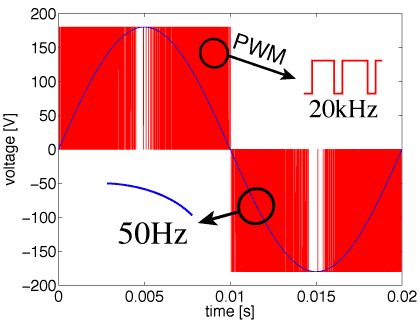
Highly integrated electric cicuits show a phenomenon called latency. That is, a processed signal causes activity only in a small subset of the whole circuit (imagine a central processing unit), whereas the other part of the system behaves almost constant over some time - is latent. Such an electric system can be described as coupled system, where the waveforms show different time scales, also refered to as multirate.
More generally, any coupled problem formulation due to coupled physical effects, may cause a multirate problem: image the simulation of car driving on the road, there you need a model for the wheel, the chassis, the dampers, the road,... (cf. co-simulation). Again each system is covered by their own time constant, which might vary over several orders of magnitude comparing different subsystems.
Classical methods cannot exploit this multirate potential, but resolve everything on the finest scale. This causes an over sampling of the latent components. In constrast, Co-simulation or especially dedicated multirate methods are designed to use the inherent step size to resolve the time-domain behaviour of each subystem with the required accuracy. This requires a time-stepping for each.
Group members working in that field
- Andreas Bartel
- Michael Günther
Former and ongoing Projects
Cooperations
- Herbert de Gersem, K.U. Leuven, Belgium
- Jan ter Maten, TU Eindhoven and NXP, the Netherlands
Publications
6.
Ehrhardt, Matthias
für Angewandte Analysis und Stochastik5.
Ehrhardt, Matthias; Günther, Michael
Mathematical Modelling of Dengue Fever Epidemics4.
Ehrhardt, Matthias; Vázquez, Carlos
Pricing swing options in electricity markets with two stochastic factors: PIDE modeling and numerical solution
3rd International Conference on Computational Finance (ICCF2019), Seite 893.
Ehrhardt, Matthias
Mathematical Modelling of Monkeypox Epidemics2.
Ehrhardt, Matthias; Günther, Michael
Numerical Pricing of Game (Israeli) Options1.
Hendricks, Christian; Ehrhardt, Matthias; Günther, Michael
Hybrid finite difference/pseudospectral methods for stochastic volatility models
19th European Conference on Mathematics for Industry, Seite 388


